
131: To Summarize...
Written January 28, 2025


Hi, everyone. Congratulations, you made it to the end of January! It’s been a rocky start to the New Year, but here we are. This month we’ve been setting the stage for our new theme in 2025: Intentional Alternatives. Each month we will examine a particular piece of our American culture and ask the questions: what are the important aspects of this piece of our culture? What are we tolerating, but maybe shouldn’t be? What collective agreements can we come to about what needs to change? And finally, what are some practical tips for implementing them to change our real, ordinary, and everyday lives?
Today, I’ll be summarizing everything discussed so far, so that we’re ready to kick off this process next week with our first topic - the economy. I will also be highlighting some interesting places where I’ve seen these conversations manifest in our culture at large.
Why Culture and What is It?
In post 128: Introduction Intentional Alternatives, I proposed that the social problems we’re facing in America are less about systems failures and more about culture. Systems are simply the mechanisms we use to institutionalize the beliefs and values that already exist in our culture. To change systems, we first have to change culture.
So what is culture? We’ve reviewed two definitions. First, from the Oxford Dictionary:
The customs, arts, social institutions, and achievements of a particular nation, people, or other social groups.
At a basic level, culture is the beliefs and customs that bind us together. Then, we examined the more provocative definition from the organizational psychologist John Amechi:
Culture is defined by our worst behaviors tolerated.
John claims it is not our aspirations that determine our culture but how low we set the bar. This led us to a new question, whose responsibility is it to set the standard?
Who Sets the Bar?
In post 129: Who Sets the Bar? we looked at attitudes towards leadership. There is a strong consensus that people at the top of any organization or group set the culture. What do we desire from those leaders? A survey in 2023, from U.S. News & World Report and The Harris Poll showed the top five traits that Americans want from their leaders are to be trustworthy, honest, hard-working, ethical, and loyal. Interestingly, curiosity, selflessness, generosity, and humility appeared at the bottom of the list.
The ideas about the best types of leadership have been debated for centuries. The Greek Philosopher Plato made an argument in 375 B.C. that the best form of government was a benevolent monarch, which he called a Philosopher King. He critiqued democracy because of the focus on private interest and believed that democratic societies were fertile soil for aspiring tyrants, competing with each other for dominance. He predicted that those most skilled at the arts of manipulation and plunder would eventually rule over everyone else.
Modern-day philosopher Dr. Richard Oxenberg proposed an interesting alternative to this paradox in a paper called Philosopher-Kings In The Kingdom of Ends. He says that in order for the ‘government of the people, by the people, and for the people’ to avoid degeneration into tyranny, the people themselves must become their own philosopher kings. We must cultivate ‘philosopher-citizens’, whose commitments extend beyond the satisfaction of private, competitive, interests.
How to Move the Bar
In last week’s post, 130: How to Move the Bar I shared a story about witnessing a weird old woman riding a moped. She seemed to defy all social norms. It made me wonder, how culture is set in the first place and how can one be liberated from it. Sociologist Bobbie Hallow provides some guidance in the book Reading for Diversity and Social Justice with the Cycle of Socialization and Cycle of Liberation.
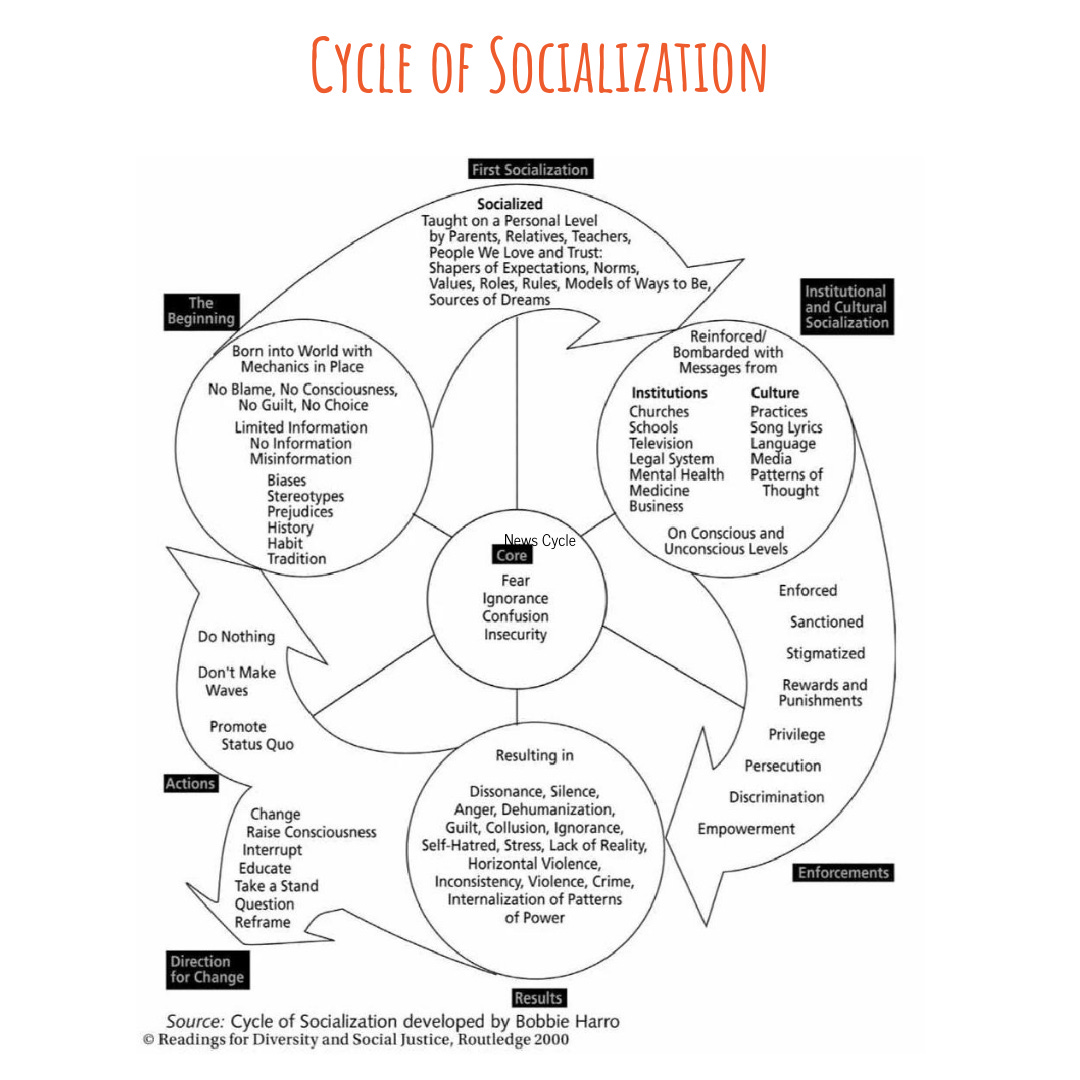
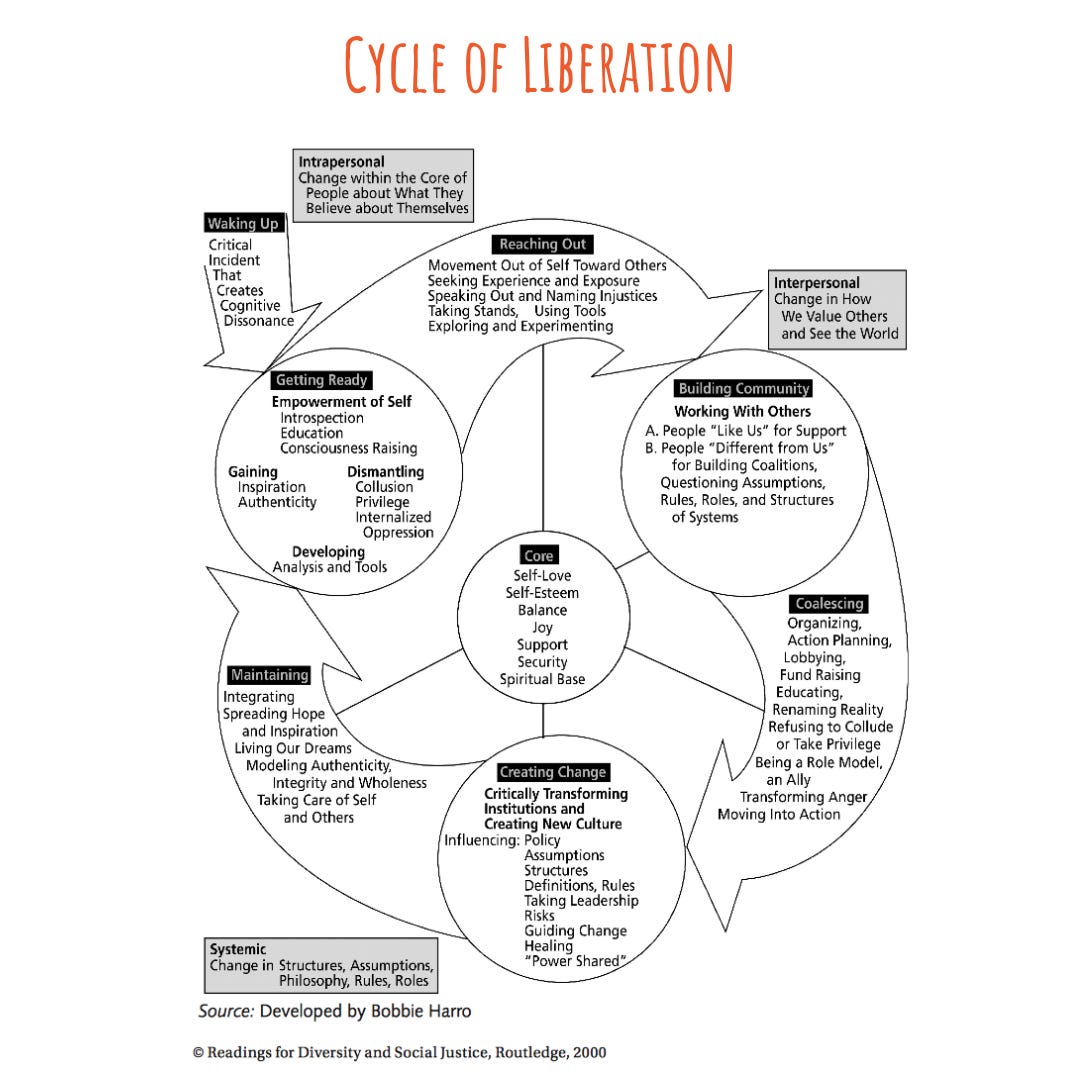
We are born into a world with existing rules, norms, and roles. At the core of socialization is fear, ignorance, confusion, and insecurity. We spend most of our lives just trying to fit in so that we’re not excluded. That works as long as our identities match the group norm, or we’re willing to push aside what doesn’t fit. Then sometimes, the cognitive dissonance becomes intolerable and we wake up.
Liberation is not rooted in fear but rather self-love, self-esteem, balance, joy, support, and security with a spiritual base. While liberation begins as an interpersonal activity, it quickly grows into systemic change. Combine the Cycles of Socialization and the Cycle of Liberation and we have a roadmap for shifting culture.
Manifestation Moments
Here are some real-life examples of places I’ve seen these ideas come to the forefront.
On a recent podcast episode of What Now? with Trevor Noah they played a silly game called If I Ruled the World. In it, Trevor makes the argument that we should completely eliminate politicians and instead adopt a system of direct democracy. His reasoning includes a look at technology and how it could be utilized to overcome obstacles faced by the ancient Greeks. The conversation starts at minute 26 and is a very fascinating thought experiment.
The New York Times recently conducted an interview with the fringe writer Cutris Yarvin who has long argued for gutting American democracy and replacing it with a “Monarchy run by a CEO”. Yarvin’s ideas are radical, but worth paying attention to because he recently found an audience with the new presidential administration and Silicon Valley. They have publicly called him a “powerful historian.” To be clear, these ideas are drastically different than those of Plato. Benevolence is completely missing from the equation.
Last Tuesday, Episcopal Bishop of Washington Mariann Edgar Budde made waves when she delivered a sermon at the National Cathedral asking President Trump to “have mercy upon the people in our country who are scared now.” When asked in an interview with Time Magazine if she was hoping to inspire others to push back against President Trump’s policies she said, “I would love to have people present another alternative, yes, and to bring compassion and breadth into our public discourse.” Bishop Budde seems to be a striking example of someone who experienced cognitive dissonance and used those feelings to move beyond the cycle of socialization to the cycle of liberation. Her bravery immediately mobilized community and many are now coalescing around her call for an alternative place to set the bar.
Basic Principles
Next month, we will begin the journey of examining a particular piece of our American culture – the economy. Here are some key ideas to keep us grounded.
We are all responsible for setting the bar. Rather than naively wishing for a benevolent monarch, we can actively work to become philosopher citizens.
The standards we hold individually contribute to the culture we create collectively.
At the core of socialization is fear, ignorance, confusion, and insecurity.
At the core of liberation is self-love, self-esteem, balance, joy, support, and security with a spiritual base.
Transforming institutions starts with recognizing the cognitive dissonance inside ourselves (a.k.a. waking up).
Intrapersonal change (what someone believes about themselves) leads to interpersonal change (how we value others/see the world).
Building community leads to coalescing, which creates change, and ultimately leads to the creation of a new culture.
Thank you for being part of this space. I’m excited to get things started and create some Intentional Alternatives!
I want to take a moment to thank everyone who is a paid subscriber to this blog. In 2025, all content will be accessible to all subscriber types. That makes paid contributions even more special. It means that you see and value my work, even when you get nothing exclusive in return. Thank you. That is a living and breathing example of an Intentional Alternative.
Reading your article felt like reaching the last part of a treacherous climb to the highest point of a mountain and finally standing at the top looking down at the world scurrying around like chickens in a box acting and reacting until we sound the same . I love the way you condensed your messsge into very readable format. You are something else Susan I love this
I enjoy your deep and thoughtful perspectives
Have no clue where / how you get the time and clarity to convey your thoughts!