
134: Social Capital
Written February 20, 2024


Hi everyone! Thanks for your patience as I took a few extra days to finish up this post. If you’re a regular reader of this blog, then you know that Kushal and I are avid snow skiers. Each winter we take a trip to visit some close friends who live in Colorado. This week, Kushal and I got to play in the land of posh privilege.
Vail, Colorado is a destination dripping with wealth. It is officially the most expensive place to ski in the world, breaking records this holiday season with individual tickets costing $329. On Sunday morning, as we put on our ski gear and prepared to ride the Gondola, mountain staff walked around handing out free slices of apple strudel from a silver platter. I kid you not. Here’s the photographic evidence:


Skiing in places like this makes me feel like an imposter. We are by no means rich, we just love a sport that is getting more and more expensive and we continuously have to find ways to do it as economically as possible.
Our home mountain is about as opposite as Vail as you can get. My entire season pass costs $539, less than two days of skiing at Vail. Rather than slope-side fine dining, you’ll see hot dogs grilled in the parking lot from the back of a pickup truck. We buy our gear second-hand or on clearance. Kushal’s helmet cost $35. At Vail, we walked into a shop with fancy helmets in a window display. Kushal looked at the price tag, then turned and looked at me with wide eyes. “Is this real, or a joke?” he asked and flashed the $750 sticker in my direction. “Very real,” I responded. His face filled with a look of disbelief. The wealth in this place is preposterous.
The reason we are able to ski at the most expensive resort in the world is not because we have unlimited amounts of cash, but rather, because of social capital. It just so happens that one of my best friends from childhood lives in Colorado. We don’t have to pay for fancy hotels or expensive rental cars. If we purchase lift tickets in July for a quarter of the cost and save up air miles, we can join our friends on a ski vacation that is beyond the feasibility for most ordinary families. That is the privilege of social capital.
In 1996, Robert Putnam introduced the concept of social capitalism in an article in the Journal of Democracy entitled Bowling Alone: America’s Declining Social Capital. In 2000, he expanded the ideas in a famous book titled Bowling Alone: The Collapse and Revival of American Community. Social capital refers to our networks of relationships that coordinate trust and cooperation and lead to mutual benefit. Putnam identified two types of social capital. First, there are bonds. These are the connections with people who are similar to us and with whom we share an identity. Second, there are our bridges. These are our relationships between people from different identity groups. Putnam argued that the strongest civil societies are the ones that have ample opportunities for bridging.
He then went on to sound the alarm of caution, stating that our bridging infrastructure in America was on a decline. Participation in spaces and groups where people from different backgrounds could interact like bowling leagues, PTA meetings, social clubs, and religious organizations was on a downward spiral. Without opportunities for inclusive bridging, our social networks were turning into exclusive bonding. This kind of exclusionary social capital sets heterogeneous bars that are either inaccessible or unwelcoming to those on the outside.
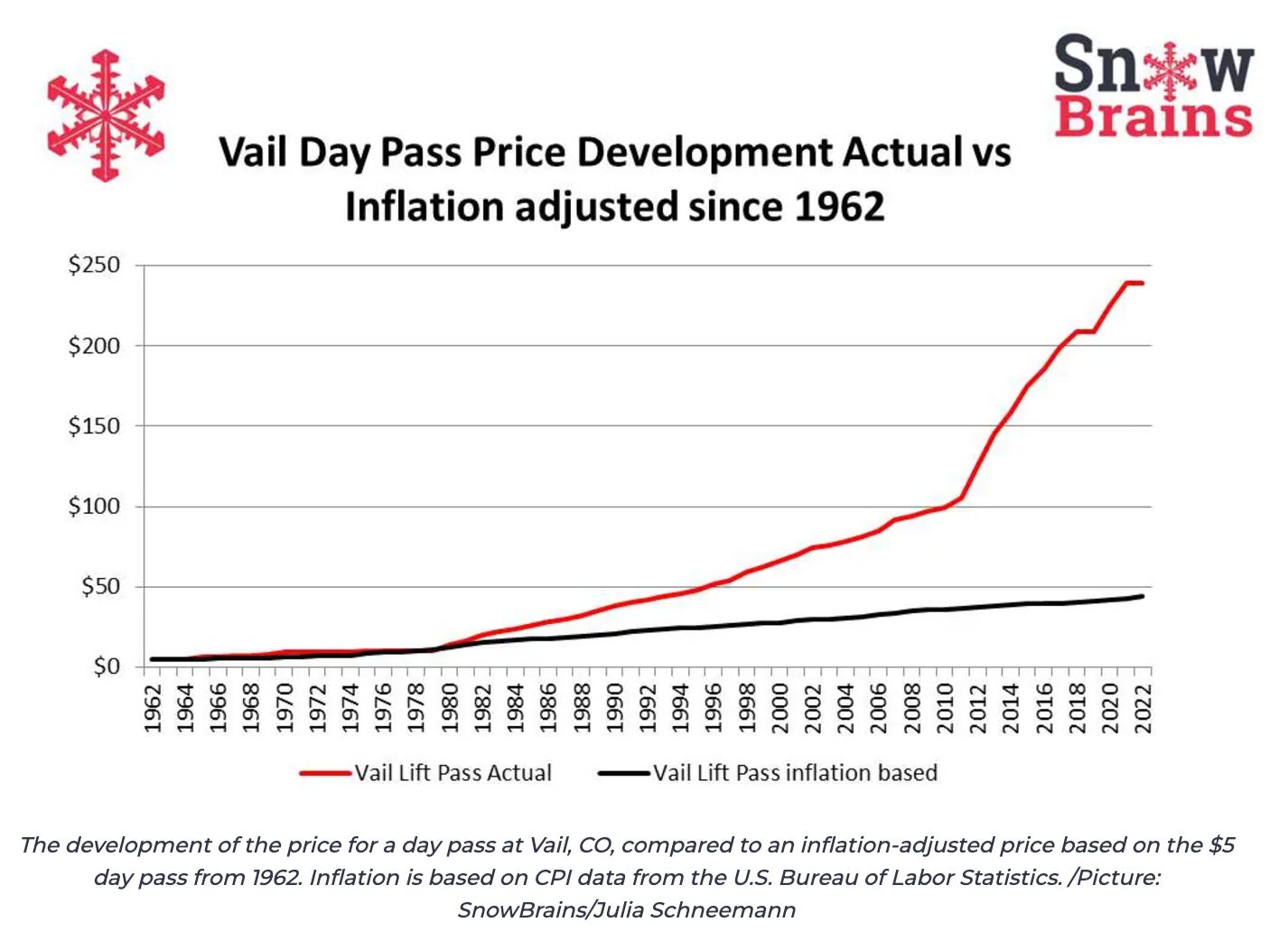
You can see this historic trend play out in the Vail Ski Resort. In 1962, when Vail opened, the daily price of a lift ticket was $5. Skiing was a social activity accessible to everyone. The steep incline in cost has come in the last 20 years, effectively shifting the sport from a bridging opportunity to an exclusive bonding practice of the wealthy.
I physically felt the exclusion at Vail. One of my favorite aspects of our home mountain is the chair lift chit-chat. The local etiquette is to ask the person sitting next to you how their day is going and where they are from. I’ve had the best 5-10-minute conversations with complete strangers on the chair lifts. It makes our local mountain feel warm and welcoming. Sometimes brief introductions lead to meaningful relationships. Recently, on our local mountain Facebook group, one woman shared she met her best friend on the chair lift and a man said he bought new gutters for his cabin from someone he met on the lift. Not once at Vail did the person sitting next to me start up a conversation. Maybe our $35 helmets gave us away as imposters, but the vibe was way different.
In 2020, Robert Putnam revised and updated the book Bowling Alone with the newest data trends on social capital and included a chapter on social media and the internet. Spoiler alert, things have not improved in the last 20 years. Bridging opportunities continue to decline.
As we begin to think about intentional alternatives to the economy, we can’t forget about social capital. Creating more opportunities for bridging is one method to disarm the exclusionary harms of capitalism. In this way, skiing at Vail felt like an act of resistance. We occupied a place we didn’t belong. I’m grateful for our friends who make the act possible. Next year, I will be the one to initiate the chair lift chit-chat. Anything to help bridge the class divide.
I want to take a moment to thank everyone who is a paid subscriber to this blog. In 2025, all content will be accessible to all subscriber types. That makes paid contributions even more special. It means you see and value my work, even when you get nothing exclusive in return. Thank you. That is a living and breathing example of an Intentional Alternative.
Weirdly, this is the second time today this book has come up for me, and I’d never heard of it previously. There is an interesting podcast today on Radio Atlantic that discusses the changing mobility of Americans and the impact privilege has on average Americans improving their economic circumstances. (There is a transcript of the podcast on The Atlantic’s Apple News landing page, if you’re interested.) Your blog dovetailed nicely with my morning read, very on point!