
184: Becoming
Written May 5, 2026

Hi everyone, I’m back! For those of you who are weekly readers, you may have wondered what happened last week. I took a week off, unannounced, which I recognize could have been confusing. Especially since it was the last week of the month, which is typically a wrap-up of the monthly theme. Sorry to leave your souls hanging! I was immersed in finishing something very big, which I’m excited to share at the end of this essay. But first, let’s kick off our new theme for May.
For those just tuning in, I write essays each week exploring what it means to be human. The theme for this year is Becoming We, where I’ve been challenging us to think of our individual selves not as an “I” but as “We.” Because that’s what humans are, not one singular thing, but a collection of multiple parts: body, mind, and soul.
So far, we’ve explored each of these pieces, defining what they are and how they function. The next step in Becoming We is integrating them all, which requires a transformation. So this month, we’re going to explore the first part of that phrase and focus on the art of Becoming.
Tricky Language
Becoming is an interesting word. It has two definitions. As an adjective, it describes something attractive, flattering, or suitable, particularly clothing or behavior. This version is fundamentally external, relational, and social, describing how something appears to others.
Imagine a group of female friends out to lunch, and one says to another, “Why, Mary, that new haircut is quite becoming on you,” while they sip tea and eat cucumber sandwiches with their pinkies in the air. That’s the adjective.
Meanwhile, as a noun or verb, becoming means the process of change or the internal process of transformation. For example, Mary might have gotten that haircut because she realized her long, beautiful brunette locks were becoming gray, and she wasn’t quite ready to accept that particular sign of aging.
So here we have a paradox. The word becoming holds a tension between external appearance and the internal reality of change. On the outside, everything can look wonderful, but inside, the change can sometimes feel uncomfortable and ugly. It’s the performance of growth versus the messy, lived truth of it.
To take it a step further, look at what our friend Mary is actually doing. She’s using the adjective version of becoming, looking flattering, to escape the verb version. Which is the ego’s oldest trick! Make the outside look one way so nobody notices the changes on the inside. In other words, she’s performing to avoid actually becoming.
Man, I love this word! Becoming linguistically holds the central tension of being human: the push and pull between who we appear to be and who we are in the process of changing into.
Yes, People Change
Whenever I talk about change, inevitably, there is a grumpy naysayer in the crowd who says, “Ah, people never change.” It’s a common phrase that suggests human beings have core, fixed traits that resist transformation. Here’s the truth, whether you like it or not: you are already becoming. Right now, as you read this, your body is changing. Your skin cells are replaced every two to three weeks. Your gut lining renews itself every four to five days, so that your stomach doesn’t digest itself. Your red blood cells are replaced roughly every 120 days, and your bones fully renew themselves over about ten years. At the cellular level, you are never the same person twice. Change isn’t something you opt into. It’s part of being human.
The only question is whether you’re aware of it.
Becoming can take two forms, conscious or unconscious. Unconscious becoming is what happens when we drift without awareness, or when we let the ego captain the ship unchecked. It’s how people end up somewhere they never intended to go. Conscious becoming is different. It’s when we wake up to the fact that we’re changing, and we start to participate in the direction of that change.
Defining Becoming
Which brings us to my definition of becoming. The Oxford Dictionary keeps the adjective separate from the verb and the noun. But I think the tension is the most interesting part. So it’s worth combining them into one. Here’s how I define becoming:
Becoming (n., v., adj.) — The ongoing process of change, conscious or not.
The question isn’t whether you are becoming. It’s who you are becoming.
That’s what this month’s theme is about. Not becoming something new from scratch, but waking up to the transformation that’s already underway. Unpacking the process of Becoming We.
The Announcement
Okay, now onto sharing the big thing I’ve been working on. Regular readers will know that Follow the Knowing is not just this Substack page, it’s also my business. These writings are one piece of a much larger endeavor. At scale, Follow the Knowing is a purpose-driven company that helps individuals and organizations tackle tough challenges.
For the past three years as a consultant, I’ve worked with companies and individuals to help them find clarity, purpose, and possibility. But admittedly, it’s felt sort of haphazard and disjointed. So, for many, many months, I’ve been taking all the ideas we’ve been exploring here on Substack and crafting a framework to be the base for all of the Follow the Knowing work moving forward. The framework is finally finished, and I think you’ll recognize it.
If I were to write a thesis for what I’ve discovered over the last three years of writing these essays, it would be this:
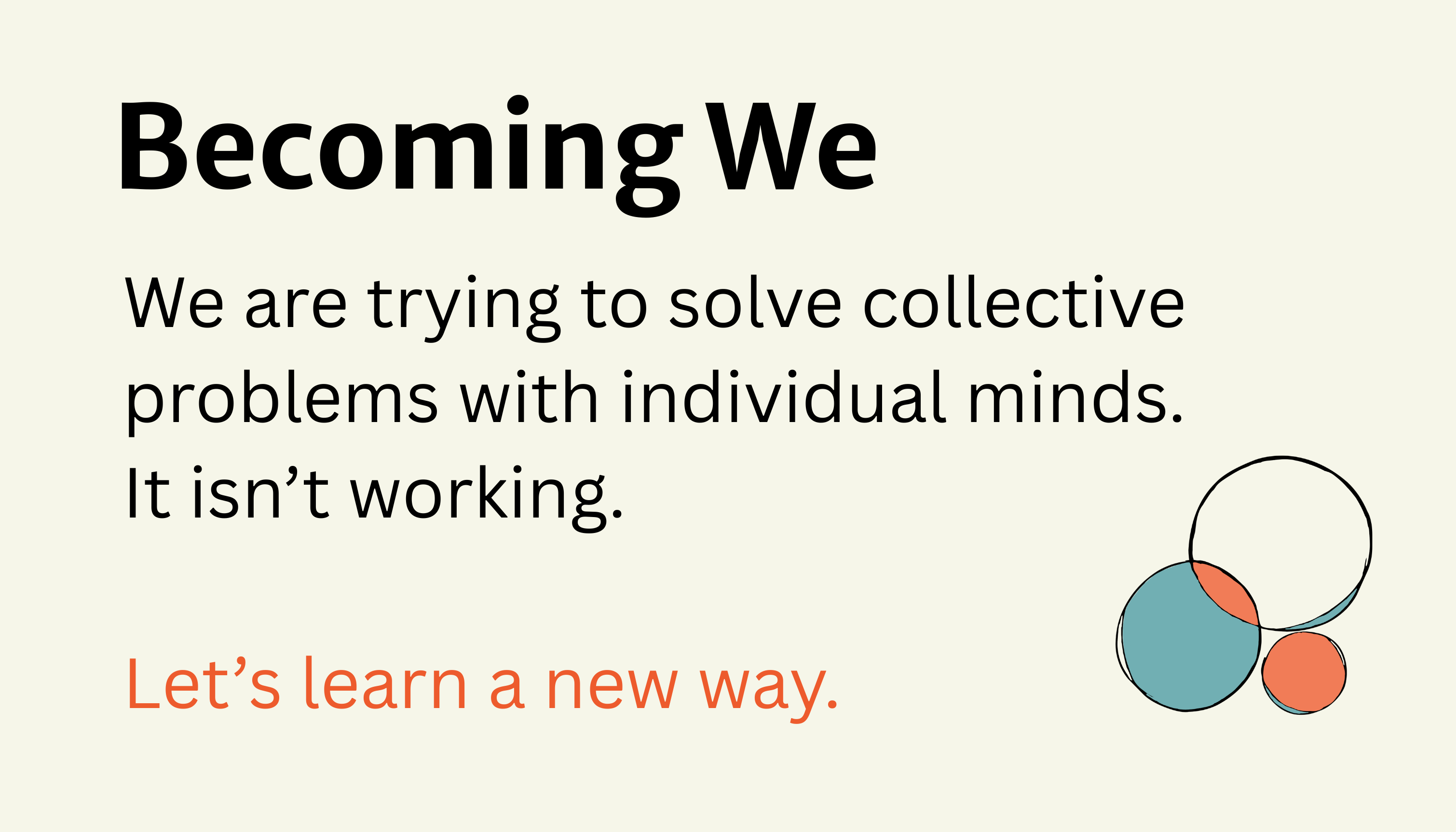
As a society, we are facing collective, planetary-scale challenges. But we are trying to solve them with minds shaped for individual survival. Until we develop a deeper sense of connection and belonging, starting within ourselves and moving outward to others, our ability to respond will remain fundamentally limited.
Thus, the Becoming We Framework emerged. It’s a structured process for moving individuals and organizations from “I” to “We.” Through workshops, group consultation, individual coaching, and this writing, it’s my way of working toward a single vision: a world that has learned to live as We.
I won’t pretend that sharing something you’ve spent years building isn’t a little terrifying. But this work feels true, and that’s enough to put it into the world.
Along with the framework comes a whole new website, a huge labor of love that I’m really proud of. I invite you to take a peek.
If any of this resonates, I'd love to explore what Becoming We could look like for you or your organization. Whether that's a workshop, a consulting engagement, or a one-on-one coaching conversation, the work is designed to meet you where you are. You can learn more and reach out at the link below.
One more thing. For those wondering what this means for the Substack, the rhythm stays the same: a new essay in your inbox every Tuesday. But I’ll be honest, for a while now, these essays have been doing a lot of heavy conceptual lifting, as I’ve been figuring out the framework in real time with you. Now that the map is drawn, I'm ready to just walk the territory. Expect more stories. More moments of catching Becoming We in the wild, in my own life, and in the world around us. That’s where this work gets interesting, and it’s probably why most of you started reading in the first place.
A final note of gratitude. These ideas didn’t emerge in isolation. They’ve been shaped, challenged, and deepened by the simple act of writing them down each week and knowing someone out there is reading. So thank you for being part of this. For asking the questions, sitting with the uncertainty, and being alongside me. It means more than I can say.
Bravo Susan for putting the framework together! I’ll be looking forward to future stories.